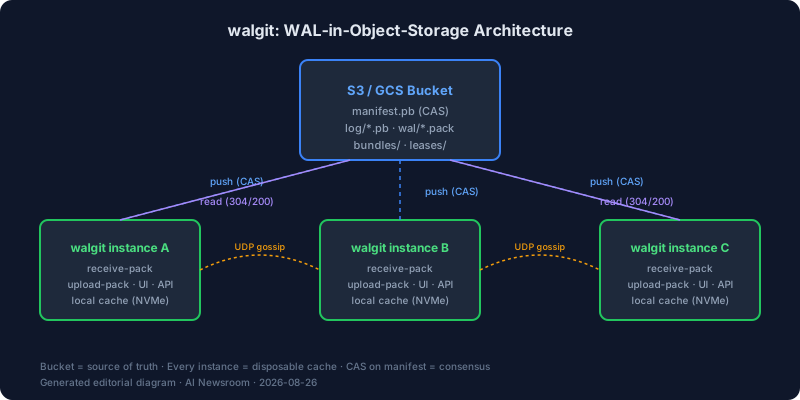
walgit is a single Rust binary that turns an S3 or GCS bucket into a stateless Git server. Created on August 23, 2026 by Tobias Lütke (Shopify CEO), it implements the architecture Cursor described in Git at any scale — the system Cursor calls Continuity (README, 2026-08-26). The repository has ~1,700 GitHub stars and 92 forks in three days (GitHub API, 2026-08-26).
Why it matters
Git hosting at scale has been stuck on Spokes: application-level replication with three-phase commit across a fixed replica set, a routing database, and local NVMe as the source of truth. Cursor’s Continuity post (cursor.com/blog/git-at-any-scale, 2026-08-18) laid out a different design: make a write-ahead log in object storage the source of truth, and make every on-disk repository a cache. A push is stored as an immutable object and becomes visible only when a tiny manifest is rewritten with compare-and-swap (CAS). That CAS is the consensus — no election, no quorum, no primary.
walgit takes that architecture and ships it as open-source Rust (README, 2026-08-26). For developers running agent-heavy workloads — throwaway repos per task, burst CI on monorepos, read replicas without a routing DB — this is the first self-hostable implementation of the pattern.
How it works
The repository stores everything under repos/<owner>/<repo>/ in the bucket (README, 2026-08-26):
- manifest.pb — tiny, CAS-rewritten. Head sequence, live pack set, checkpoint pointer, settings. The linearization point.
- log/*.pb — immutable entries: PUSH, COMPACT, CHECKPOINT, SETTINGS.
- wal/*.pack — content-addressed packs with side-files (idx, rev, bitmap, commit-graph).
- checkpoints/ — folded ref snapshot + pack inventory for cold starts.
- bundles/ —
bundles/listfor clones,bundles/catchupfor fetches. - leases/ — CAS with TTL, the only cross-instance mutex.
A push indexes the pack, checks connectivity and policy, uploads pack + idx + log entry, then CASes the manifest. On a 412 (concurrent conflict), it re-reads, re-validates every ref, and retries (README, 2026-08-26).
A read does one conditional GET of the manifest. A 304 means serve from local cache; a 200 means apply new entries before serving. Reads are consistent without coordination.
The bucket is the repository. Every local disk is a cache. Kill all instances and you lose warmth, nothing else.
What it does
walgit supports (README, 2026-08-26):
- Smart HTTP v0/v2 — fetch (filter/shallow/deepen/sideband-all), push (atomic, deletes, tags, push options, report-status-v2),
owner/reponamespaces, SHA-1 and SHA-256 repos. - bundle-uri — fresh clones download a full + chain from the bucket; catch-ups download exactly the slots missed. Static files the bucket or CDN hands out.
- LFS — batch API, objects in the bucket, optional read-through from an upstream server.
- Web UI + API — React tree/blob/commits/diffs UI, JSON API under
/{owner}/{repo}/api/*, streaming SSE for long answers.repos.jsSDK for pages, agents, and scripts. - Per-repo push policy — protected refs, groups, fast-forward only, bypass lists.
- Auth —
none(loopback),token(static tokens),oidc(any OpenID Connect issuer). - Stores — S3, S3-compatible (AWS, MinIO, rustfs, R2, Ceph), GCS, in-memory (test only). No SSH transport.
Practical implications
- One-binary deployment.
walgit serve --config walgit.toml. No database, no routing table, no local state that matters. - Disposable replicas. Agent workloads creating millions of throwaway repos get one replica each. Idle repos are garbage-collected; the next fetch materializes from the WAL.
- Burst CI for monorepos. Scale read replicas horizontally — the Continuity design Cursor tested with 100 replicas and saw consistent linear scaling for reads (Cursor blog, 2026-08-18).
- Cost model. Round trips to the bucket are the budget. Cursor reports ~120 pushes/s on S3 Standard, ~300 on S3 Express One Zone (Cursor blog, 2026-08-18). walgit implements the same pattern.
- repos.js SDK. Dependency-free SDK for building pages, agent interfaces, and scripts against the API.
Risks and caveats
- Three days old. Created August 23, 2026. No tagged releases, 3 contributors, 3 open issues as of August 26 (GitHub API). Treat as early-stage.
- Owner-centric early project. The repository is owned by a single GitHub user, tobi (Tobias Lütke), with two other contributors so far. Supply-chain caution applies — no multi-maintainer review gate yet.
- Requires object storage. You need S3/GCS credentials and a bucket. Token or OIDC auth only; no org RBAC UI.
- Scale figures are Cursor’s, not walgit’s. The ~120 pushes/s and ~300 pushes/s numbers come from Cursor’s stress tests of the Continuity design, not from walgit benchmarks (Cursor blog, 2026-08-18).
- Architecture lineage is explicit. walgit keeps a verbatim copy of the Cursor post under
docs/reference/and credits it in the README. This is an implementation of Cursor’s design, not an independent invention.
What to watch
- First tagged release — when does walgit ship a versioned binary?
- First independent benchmark — someone other than Cursor measuring push throughput on the walgit binary.
- First non-Lütke major feature — community contribution that shapes the project’s direction.
- Agent-harness adoption — does walgit show up as the Git backend in dsh, Codex CLI, or similar tooling?
- Cursor publishing Continuity details walgit doesn’t reproduce — the blog post is the public spec; the implementation may diverge.
- bundle-uri config for multi-tenant buckets — how walgit handles shared storage across organizations.
Sources
| # | Source | Type | Date | URL |
|---|---|---|---|---|
| 1 | tobi/walgit — GitHub repository (MIT, Rust, ~1.7K stars, 92 forks) | Primary | 2026-08-26 | https://github.com/tobi/walgit |
| 2 | tobi/walgit — README (capabilities, architecture, Cursor lineage) | Primary | 2026-08-26 | https://github.com/tobi/walgit#readme |
| 3 | Cursor engineering blog — “Git at any scale” (Vicent Martí, Continuity architecture) | Primary | 2026-08-18 | https://cursor.com/blog/git-at-any-scale |
| 4 | tobi/walgit — docs/reference/cursor-git-at-any-scale.md (verbatim copy) | Primary | 2026-08-26 | https://github.com/tobi/walgit/blob/main/docs/reference/cursor-git-at-any-scale.md |
| 5 | GitHub API — tobi/walgit repo metadata | Secondary | 2026-08-26 | https://api.github.com/repos/tobi/walgit |