OpenWiki: LangChain's CLI that lets agents maintain their own docs
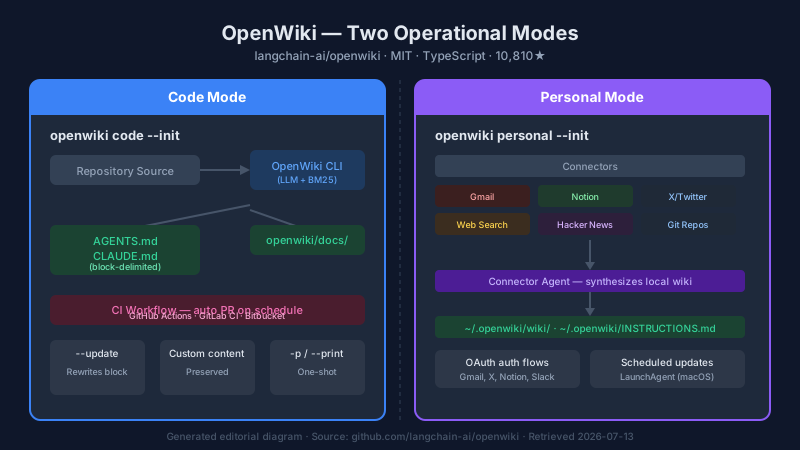
OpenWiki reached 10,810 stars on GitHub in three weeks — a signal that agent-maintained documentation is a real pain point the ecosystem is ready to solve.
What happened
LangChain released OpenWiki, a TypeScript CLI that writes and maintains agent-facing documentation for any codebase. It ships with two modes: code mode generates an AGENTS.md, CLAUDE.md, and a full openwiki/ documentation directory from repository source code; personal mode builds a local wiki at ~/.openwiki/wiki/ from configured data sources.
OpenWiki supports five inference providers out of the box — OpenAI, Anthropic, OpenRouter, Fireworks, Baseten, and NVIDIA NIM — plus any OpenAI-compatible endpoint. Users configure the model and API key during first-run onboarding.
The tool reached 10,810 stars, 740 forks, and 113 open issues since its public debut on June 22, 2026. The latest release, v0.1.1, shipped on July 11. It has 106 commits on the main branch and is developed primarily in TypeScript (84.4%) with JavaScript (15.6%).
How it works
Install via npm:
npm install -g openwikiInitialize in either mode:
# Personal brain — local wiki from connectors
openwiki personal --init

# Code documentation — AGENTS.md, CLAUDE.md, openwiki/ dir
openwiki code --init
In code mode, OpenWiki maintains an AGENTS.md and CLAUDE.md at the repository root. Each file contains a <!-- OPENWIKI:START -->…<!-- OPENWIKI:END --> block that the tool rewrites on each run, preserving any custom content outside the block.
Personal mode builds a wiki from local connectors: local Git repos, Gmail, Notion, X/Twitter, Web Search (Tavily), and Hacker News. Connectors are configured during first-run onboarding and can be added or removed later. Authentication flows use OAuth where applicable: Gmail and X use direct OAuth, Notion targets its hosted MCP server, Slack walks through a local OAuth flow with ngrok.
Why it matters
Agent documentation is a new category. OpenWiki is the clearest example in 2026 of “the agent maintains its own reference docs” — replacing the old workflow where humans write documentation for agents to read.
The CI integration is the key differentiator. OpenWiki ships ready-to-use workflows for GitHub Actions, GitLab CI, and Bitbucket Pipelines that automatically open pull requests or merge requests with documentation updates. For GitHub Actions, the workflow can run on a schedule without needing --init — --update creates the initial docs if they do not exist. This means documentation stays current without human intervention.
Provider flexibility reduces vendor lock-in. Users can route through Anthropic, OpenAI, OpenRouter, any OpenAI-compatible gateway, or even a ChatGPT login (which draws on ChatGPT subscription usage rather than API billing). For teams running a LiteLLM gateway, setting OPENWIKI_PROVIDER=openai-compatible with a custom base URL lets all providers behind that gateway be reached through a single configuration.
Practical implications
Teams already using Claude Code, Cursor, or GitHub Copilot can wire OpenWiki into their workflow in about 15 minutes:
| Step | Action |
|---|---|
| 1 | npm install -g openwiki && openwiki code --init |
| 2 | Configure provider + API key during onboarding |
| 3 | Copy the CI workflow for your Git provider |
| 4 | Commit the workflow file and push |
The generated AGENTS.md and CLAUDE.md instruct the coding agent to reference the openwiki/ documentation when searching for context. On each CI run, OpenWiki rewrites only its own block-delimited sections, leaving any hand-written agent instructions intact.
OpenWiki’s approach is complementary to other memory and context tools. Unlike Ratel (which reduces token usage via BM25 tool selection) or Headroom (which compresses conversation history), OpenWiki solves a different problem: making the codebase knowable to the agent in the first place.
Risks and caveats
OpenWiki depends on Node.js and npm (or pnpm). Windows users need Visual Studio Build Tools with the Desktop development with C++ workload for the better-sqlite3 native dependency — and bun install -g openwiki skips lifecycle scripts by default, so it will not warn before hitting that build step.
The personal mode wiki and all connector data — Gmail messages, X/Twitter posts, Notion pages — are stored locally at ~/.openwiki/. This is privacy-positive (no cloud sync by default), but it also means no built-in backup or multi-device sync.
Provider API costs scale with documentation size. Every --update run sends the entire repository context through the model. For large monorepos, each full update cycle could cost several dollars in API calls depending on the provider and model tier. OpenWiki’s retry default of 3 attempts per provider request can compound this on transient failures.
The project is three weeks old. Its v0.1.1 release, 106 commits, and 113 open issues indicate active development but also a surface area still in flux. There is no documented snapshot quality benchmark — users should review generated docs before committing CI auto-PRs to production branches.
What to watch
OpenWiki is the first tool of its kind from LangChain, a team with distribution in the agent ecosystem. If the project maintains its current trajectory, expect follow-on integrations: hosted wiki hosting, team-shared agent documentation, and deeper IDE integration. The open issues point to demand for MCP server support, custom template formats, and incremental (rather than full) documentation updates.
The broader pattern — agents writing their own reference documentation — is likely to spread across the ecosystem in the second half of 2026. OpenWiki provides the template.