Mistral opens Leanstral 1.5: 6B-active Apache-2.0 Lean 4 prover

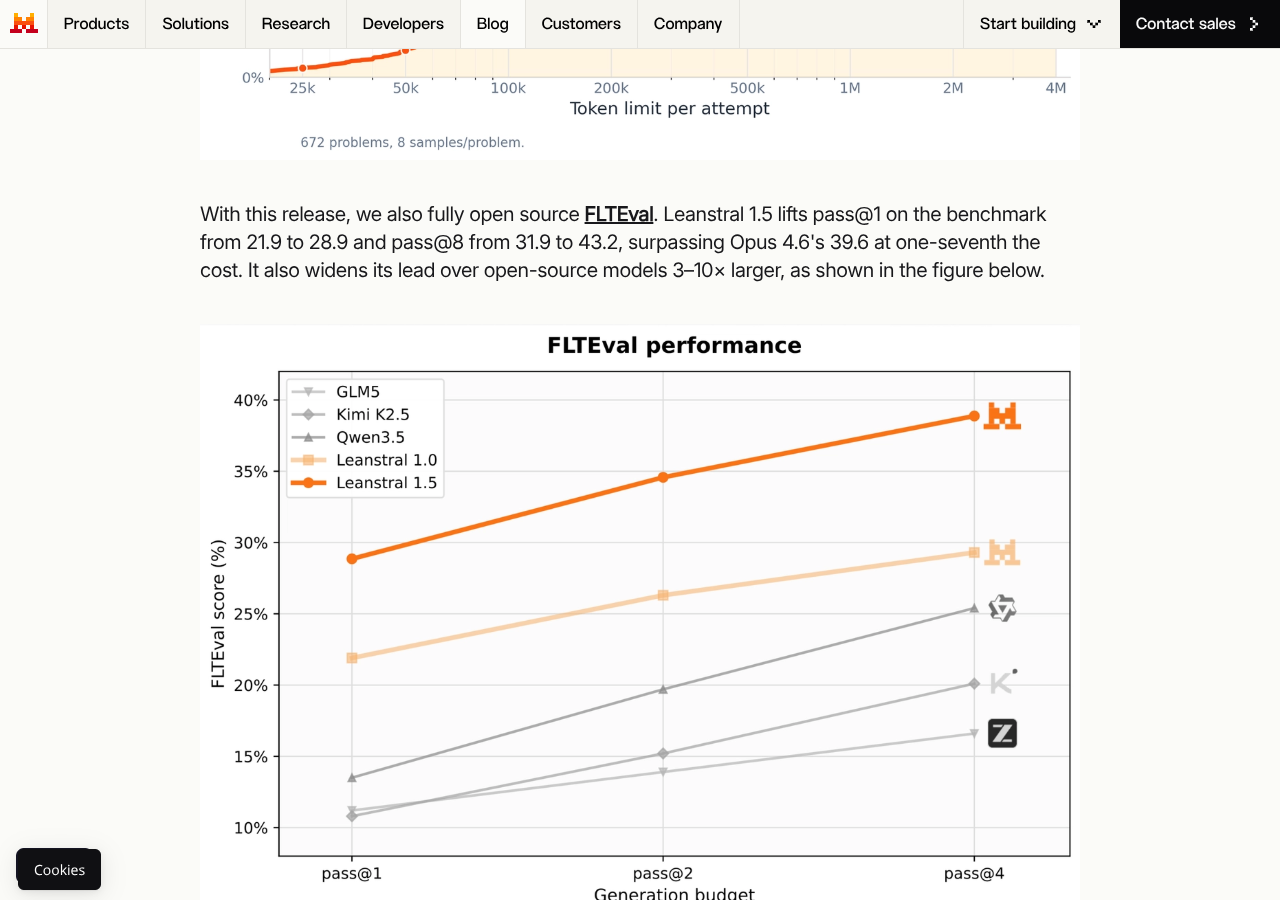
Mistral AI released Leanstral 1.5 on 2026-07-02 — an Apache-2.0, 119B/6B-active MoE for proof engineering in Lean 4. It saturates miniF2F, solves 587 of 672 PutnamBench problems, sets SOTA on FATE-H (87%) and FATE-X (34%), and lifts FLTEval pass@8 from 31.9 to 43.2 — past Opus 4.6’s 39.6 at ~1/7 the cost. Weights are on Hugging Face; a free leanstral-1-5 API is live.
What happened
Leanstral 1.5 is the second-generation release in Mistral’s Leanstral line (the first is Leanstral-2603). It is a 119B/6B-active MoE — 128 experts / 4 active per token, 256k context, multimodal input (text + image → text) — small enough for one consumer node, large enough to learn deep proof structure (Mistral blog, 2026-07-02). Training runs mid-training → SFT → RL with CISPO in two custom environments that return feedback from a real Lean compiler.
The multiturn Lean verifier gives the model a theorem, returns the Lean compiler’s verdict, and loops until the proof compiles. The code agent environment gives it a filesystem, bash, and the Lean language server; it edits files, builds auxiliary lemmas, and survives many rounds of context compaction. Final proofs are checked by Mistral’s fork of SafeVerify.
Why it matters
- Open weights. Apache-2.0 means anyone can run, fine-tune, or audit; Seed-Prover 1.5 and Aleph Prover are API-only.
- Consumer hardware. 6B active parameters fit on one high-memory workstation; Mistral puts Seed-Prover 1.5 high at 10 H20-days per problem.
- A working install path via Mistral Vibe →
/leanstall→vibe --agent lean, plus an optional Lean LSP MCP. - FLTEval is now open source — released alongside the model as a community yardstick for real-PR proof engineering.
Benchmarks and cost
All numbers from the Mistral blog post, 2026-07-02.
| Benchmark | Leanstral 1.5 | Best open | Best closed |
|---|---|---|---|
| miniF2F (val + test) | 100% / 100% | n/a | n/a |
| PutnamBench (of 672) | 587 | A-ProverBase 365 | Aleph Prover 668; Seed-Prover 1.5 high 580 |
| FATE-H | 87 (SOTA) | A-ProverBase 66 | Seed-Prover 1.5 high 80 |
| FATE-X | 34 (SOTA) | A-ProverBase 24 | Seed-Prover 1.5 high 33 |
| FLTEval pass@1 / pass@8 | 28.9 / 43.2 | 21.9 / 31.9 | Opus 4.6: 39.6 pass@8 (~7× the cost) |
Cost framing (vendor estimates). Mistral reports ~$4 per PutnamBench problem for Leanstral 1.5, $300+ per problem for Seed-Prover 1.5 high, $54–68 per problem for Aleph Prover. No closed prover publishes per-problem cost independently.
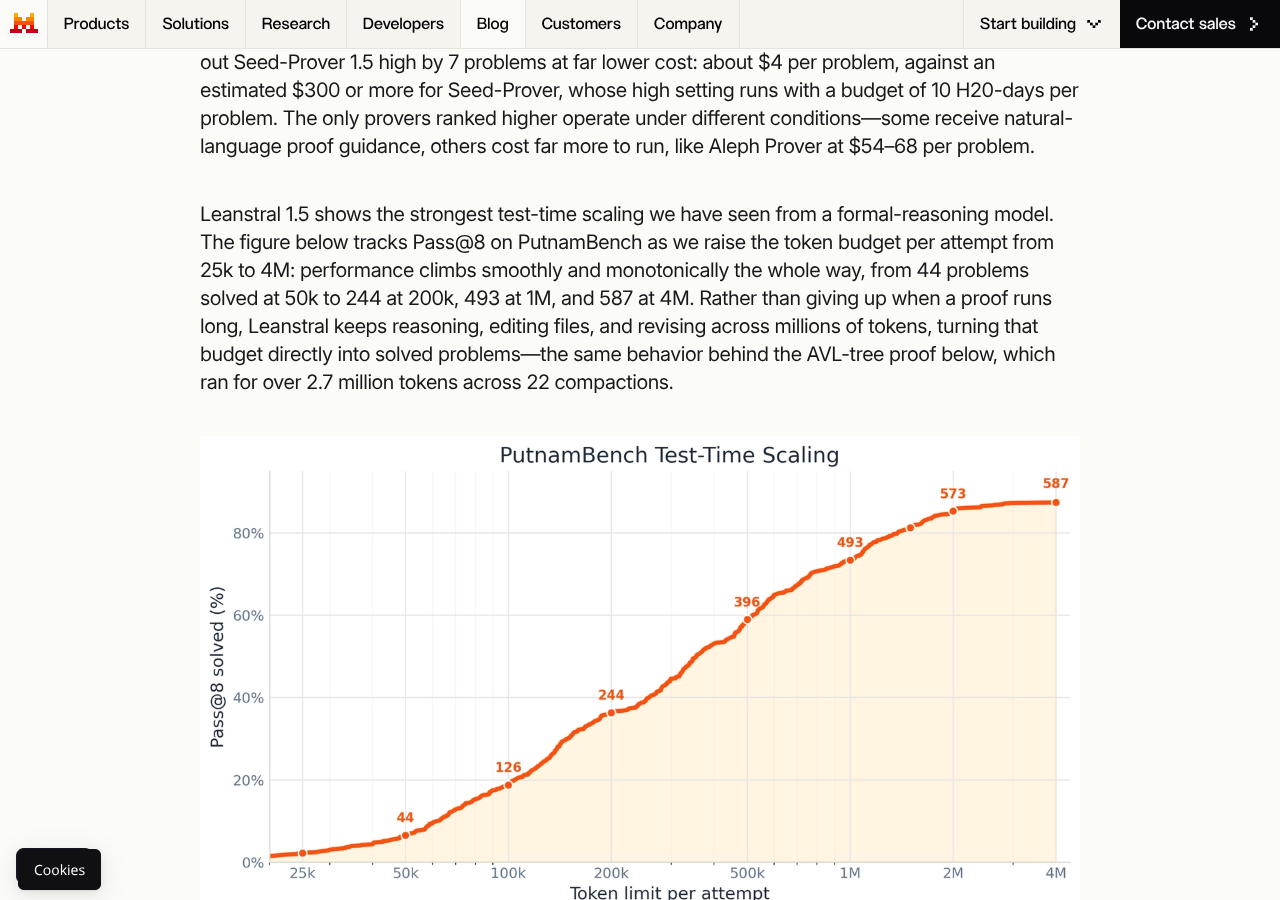
Test-time scaling. PutnamBench Pass@8 climbs monotonically with per-attempt tokens: 44 at 50k → 244 at 200k → 493 at 1M → 587 at 4M. Not plateauing at 4M.
Real-world bug discovery
Mistral ran a verification pipeline against 57 Rust repos using Aeneas (Rust → Lean), intent inference, and 4 attempts to prove + 4 to disprove each generated property. Result: 47 violated properties flagged, 11 genuine bugs, 5 previously unreported on GitHub (no CVEs at the time of writing).
- AVL tree time-complexity proof. A real AVL implementation was proven
O(log n)for insert and delete via structural induction on theTimeMmonad — 2.7M+ tokens across 22 compactions, almost-tight bound of 48 steps per height unit plus a constant. - U64 overflow in
datrs/varinteger. Zigzag-decodingvalue + 1overflows onStd.U64.MAX— debug crash, silent release corruption.
Alongside the model, Mistral also fully open-sourced the FLTEval harness at github.com/mistralai/FLTEval (Apache-2.0) — a Docker-only SWE-bench-shaped harness that applies submitted diffs inside per-task images, runs Lean and SafeVerify, and writes per-instance and aggregate reports.
Practical implications for builders
uv tool install mistral-vibe && uv tool update mistral-vibe && vibe --setup
/leanstall
exit
vibe --agent lean
# Optional: Lean LSP MCP in ~/.vibe/config.toml- Maintain a Rust library? Point Leanstral at a real PR — the 57-repo Aeneas pipeline is the closest reproducible demo.
- Research formal methods? Open weights + CISPO RL is a new baseline; SafeVerify and FLTEval are open source.
- Ship Lean 4 production code? The optional Lean LSP MCP is the real unlock — Leanstral drives
lean_goaland iterates on stuck goals. - Just want to try it? The free
leanstral-1-5API endpoint is the shortest path; no weights, no GPU.
Risks and caveats
- Benchmark-vs-real-world gap. The 5-of-11 true-bug rate is a useful signal, not a guarantee.
- Lean 4 only. No Coq, Isabelle, Rocq, Agda, or HOL Light support.
- Vendor cost estimates. The $4 vs $300+ vs $54–68 framing is from Mistral; closed provers do not publish per-problem cost independently.
- No CVEs on the 5 unreported bugs. Do not claim CVE ids in derivative coverage.
- LeanstralSafeVerify is a fork of SafeVerify; may not generalise to Lean projects with custom build setups.
- PutnamBench is more crowded than it looks. Aleph Prover solves 668/672 at higher per-problem cost; some higher-ranked results use NL proof hints that Leanstral 1.5 does not.
What to watch
- Independent reproductions of FATE-H/X and FLTEval numbers.
- CVE assignments and upstream patches for the 5 previously unreported bugs.
- Mistral Vibe adoption — 6B-active open weights + an agent harness is a low barrier.
- FLTEval adoption as a community benchmark.
- Follow-on releases — Leanstral 1.6 or distilled variants have not been announced; Mistral has no published roadmap as of 2026-07-04.
Sources
- Mistral AI — “Leanstral 1.5: Proof Abundance for All” — 2026-07-02
- Hugging Face —
mistralai/Leanstral-1.5-119B-A6Bmodel card — 2026-07-02 - Mistral AI — Leanstral 1.5 API model card — 2026-07-02
- GitHub —
mistralai/FLTEval(open-source benchmark) — 2026-07-02 - GitHub —
mistralai/LeanstralSafeVerify(Mistral’s fork) — 2026-07-02 - GitHub —
datrs/varinteger(U64 overflow case) — 2026-07-02 - Lean 4 reference site
- GitHub —
oOo0oOo/lean-lsp-mcp(optional MCP integration) - AI Newsroom — sitemap (no prior Leanstral or Mistral article on news.lesbass.com before 2026-07-04)