DeepSeek ships `dsh`: MIT agent harness
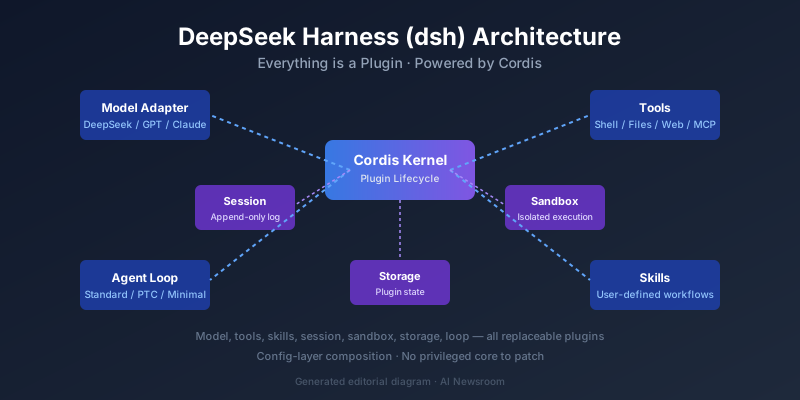
On 2026-08-19, deepseek-ai/deepseek-harness — DeepSeek’s open-source agent harness — sits at ~165K GitHub stars, 17.5K forks, MIT license, TypeScript (GitHub, 2026-08-19). The README states: “DeepSeek Harness (dsh) is an open-source agent harness developed by DeepSeek AI. It uses an architecture where everything is a plugin, and is powered by Cordis” (README, 2026-08-19). The latest release is dsh-v0.1.0-rc.7 (pre-release, published 2026-08-17) (Releases, 2026-08-19).
What it is
A plugin-first agent harness. Every agent capability — model adapter, tools, skills, session, sandbox, storage, agent loop, UI — is a Cordis plugin. Developers swap any component at configuration time without touching dsh source (README, 2026-08-19).
Powered by Cordis. Cordis is a “Meta-Framework of Spatiotemporal Composability” — a TypeScript runtime for dynamic plugin composition with revertible effects and reactive coeffects (cordiverse/cordis, 2026-08-19). The accompanying paper formalizes the paradigm: “A Programming Paradigm for Spatiotemporal Composability” (cordiverse/paper, 2026-08-19).
Four run modes:
- Standard — full tool set (file editing, shell, web search, MCP, skills, subagents)
- PTC — model generates TypeScript code that orchestrates multi-step tool calls
- Minimal — persistent bash + file editor only, for benchmarking
- Creative — runtime inspection, plugin experimentation, preset authoring
Quick start: npx @deepseek-ai/dsh web serves a Web UI at http://127.0.0.1:3080. From source: clone, pnpm install, pnpm run build, pnpm dsh web (README, 2026-08-19).
Why it matters
The “everything is a plugin” claim is architectural, not marketing. Cordis manages plugin lifecycle — loading, unloading, dependency resolution — without a privileged core. The README explicitly warns: “THERE WILL BE COMPATIBILITY-BREAKING CHANGES.” This is a developer preview, not a production API (README, 2026-08-19).
The dsh-plugin ecosystem is already large. The dsh-plugin GitHub topic lists 7,957 public repositories as of 2026-08-19, including desktop clients, design tools, resume builders, memory systems, and diagram generators (GitHub Topics, 2026-08-19).
Agent harnesses are a 2026 pattern. Prior coverage: oh-my-pi (2026-06-26) treated the harness as the product. dsh takes the opposite approach: the harness is the infrastructure, and the product is the plugin ecosystem.
Practical implications
- Evaluating agent architectures. dsh makes the plugin boundary explicit. Compare how model adapters, tool interfaces, and session management are wired — not just which model is behind the API.
- Building dsh plugins. The
dsh-plugintopic andawesome-dsh-pluginlist (awesome-dsh-plugin, 2026-08-19) provide reference implementations. Cordis primitives (effects, coeffects, component lifecycle) are the foundation. - Running dsh today. One command:
npx @deepseek-ai/dsh web. No Docker, no cloud account. The developer preview means breaking changes are expected — pin a release tag for any real work.
Risks and caveats
- Developer preview. The README’s all-caps compatibility warning is explicit. Do not treat dsh as production-ready or API-stable.
- Star count is a launch signal, not a stability signal. ~165K stars in under a week reflects DeepSeek’s brand weight. Independent adoption and plugin quality are the real metrics.
- Cordis is also pre-stable. Its README states: “The API is not yet stable and may change without notice” (cordiverse/cordis, 2026-08-19).
- No head-to-head benchmarks against Claude Code / Codex / OpenCode. The article does not claim dsh is “better than” any competing harness.
- The dsh-plugin count (7,957) is self-reported by GitHub topic tagging. Quality and maintenance vary widely.
What to watch
- First stable release — when does
v0.1.0leave pre-release? - Cordis paper peer review — the preprint is dated August 13, 2026; academic validation would strengthen the architectural claims
- Plugin quality signal — are the 7,957 repos maintained, or fork-farmed?
- Competing harness responses — how do Claude Code, Codex CLI, and OpenCode adapt to a plugin-first architecture?
- Production usage reports — any teams running dsh beyond prototyping?
Sources
| # | Source | Type | Date | URL |
|---|---|---|---|---|
| 1 | GitHub — deepseek-ai/deepseek-harness (README, LICENSE, file listing) | Primary | 2026-08-19 | https://github.com/deepseek-ai/deepseek-harness |
| 2 | GitHub — deepseek-ai/deepseek-harness README.md (exact phrasing, developer preview banner) | Primary | 2026-08-19 | https://raw.githubusercontent.com/deepseek-ai/deepseek-harness/master/README.md |
| 3 | GitHub — deepseek-ai/deepseek-harness Releases (dsh-v0.1.0-rc.7, 2026-08-17) | Primary | 2026-08-19 | https://github.com/deepseek-ai/deepseek-harness/releases |
| 4 | GitHub — cordiverse/cordis (6.3k stars, MIT, Meta-Framework) | Primary | 2026-08-19 | https://github.com/cordiverse/cordis |
| 5 | GitHub — cordiverse/paper (A Programming Paradigm for Spatiotemporal Composability, preprint Aug 13 2026) | Primary | 2026-08-19 | https://github.com/cordiverse/paper |
| 6 | deepseek.com/harness — Official product page | Primary | 2026-08-19 | https://deepseek.com/harness |
| 7 | GitHub Topics — dsh-plugin (7,957 public repositories) | Primary | 2026-08-19 | https://github.com/topics/dsh-plugin |